

Industrial net lease sales market weathers interest rate headwinds
B+E > B+E INSIGHTS > B+E Research and Insights > Industrial net lease sales market weathers interest rate headwinds
12/08/2022
By
B+E
Industrial net lease sales market weathers interest rate headwinds
Industrial Net Lease Investment Outlook
Buyers and sellers across the commercial real estate market are dealing with the new reality of higher interest rates. Investment activity and cap rates in the industrial net lease market appear to be holding up amid rising capital costs, and B+E anticipates a robust pace of activity in the last quarter of 2022 as motivated sellers bring more inventory to the for-sale market.
Fed rate hikes have pushed some market participants to take a pause to read the market and see where pricing might be headed. However, that pause is more evident on the buy side where investors are reevaluating acquisition criteria and financing strategies given the fluctuation in interest rates.
Supply increased over the first half of 2022 for industrial assets, however, demand is still outpacing what’s available for credit tenants. “Valuations remain very strong with more owners wanting to sell to take advantage of the current pricing” says B+E industrial broker William Brooks. “People know that if they’re going to sell, now is the time to do it before the market moves too much.” This sustained demand, as well as a boost in e-commerce activity from the upcoming holiday season, will keep valuations very strong and lead to more and more owners selling to take advantage of current prices.
In the near term, uncertainty in the market related to slowing economic growth is likely to drive a flight to quality and greater demand for investment grade and recession-resistant tenants. For example, NNN FedEx assets are highly sought after by investors and are generating very competitive pricing. According to B+E’s research, FedEx NNN assets are listed at an average asking price of approximately $15,585,000 as of November 9th, 2022. Data also shows that FedEx net lease demand is driving further cap rate compression with an average of 5.27% among transactions listed currently, more than 50 basis points lower than the 5.80% average cap rate in 2021.
Cap rates remain stable
Cap rate compression has been a hot topic across the NNN industrial market over the past 18 months. With the Fed continuing to raise interest rates, there is considerable discussion and speculation of how higher rates may impact cap rates. Although there is not a direct correlation between Fed rate increases and long-term borrowing rates, rising rates are putting pressure on yields for leveraged buyers. However, cap rates for industrial assets have not moved significantly.
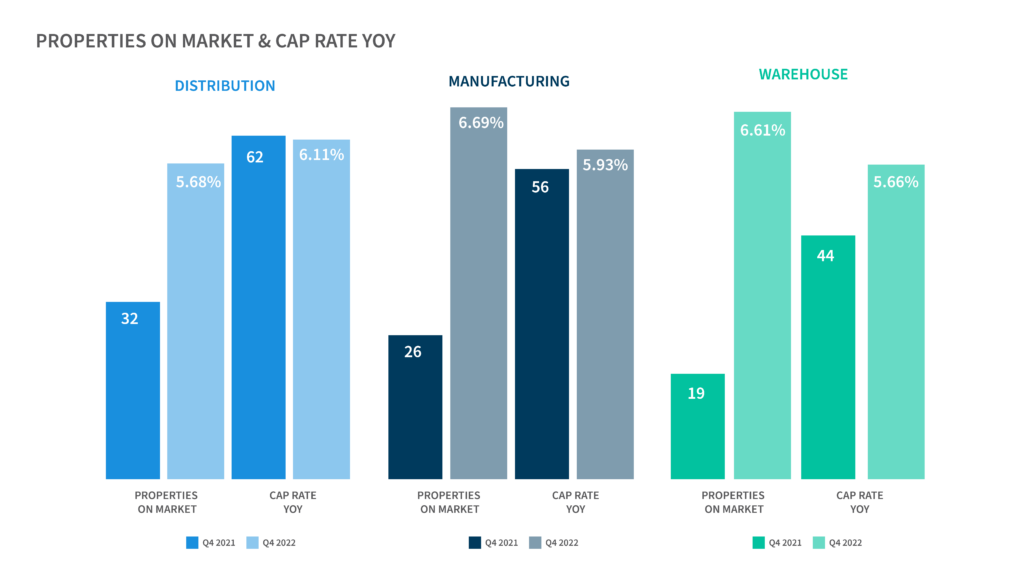
According to B+E’s Q4 Cap Rate Report, net lease warehouse facilities saw cap rates increase 109 basis points so far in the fourth quarter compared to Q3, to average of 6.05% as of November 9th, 2022. It’s also important to note that the increases we’ve seen are coming on the heels of what has been record cap rate compression. So, it is likely that cap rates for these assets have reached the bottom for this cycle, but they still remain relatively low for best in class assets, notes Brooks.
Competitive cap rates are a byproduct of strong buyer demand and more capital that has been targeting net lease industrial assets. The hands-off style of passive investments with longer lease terms and reliable cash flows are commanding premium pricing. At B+E, we’ve seen bidding wars between buyers, often leading to industrial assets being sold at or above asking price in this market. Over the past year, there has been a flood of new entrants in the industrial net lease market, which has further added to what was already fierce competition. Cross-border and institutional capital, as well as REITs, have been on a massive buying spree. Even giant investment firms, which we have not traditionally been active in the net lease space, have launched multi-billion dollar net lease platforms.
Competition has prompted the larger institutional buyers to look at smaller markets and non-institutional tenants that can offer better yields. For example, B+E brokers sold the Opus Packaging Industrial Portfolio in April of this year that included three assets located in secondary and tertiary midwestern markets for $35.5 million that achieved a record low cap rate for their respective markets. B+E generated multiple offers on the portfolio from various private and institutional groups. The pricing highlights the quality of the assets and the effectiveness of a competitive bid process, as well as strong buyer demand in the market for industrial NNN assets.
Industrial remains high demand sector
Growth in e-commerce sales and supply chain disruption have fueled avid investor interest in all types of industrial assets. As consumers are ordering more of everything online these days from groceries to clothing, retailers are gobbling up last-mile distribution space wherever they can. Supply chain disruption has also led to retailers who are willing to pay a premium for industrial space in order to keep more inventory on hand. The increased demand and limited supply of available industrial properties for lease, particularly in gateway and port markets, has resulted in extraordinarily strong property valuation growth over the past 18 months.
The lack of space and overwhelming demand is contributing to record low vacancies and record high annual rent growth in many markets across the country. Additionally, tenants are often pre-leasing space before construction is complete and asking for longer term leases to lock down space in this competitive market. A robust development pipeline is bringing more inventory to the market. Many companies are also converting prior retail properties into industrial facilities, turning dark stores into micro-fulfillment centers and last-mile distribution hubs as the demand from consumers remains high and will remain high as we approach the holiday season..
Amazon’s April announcement that it was slowing its expansion and planning to sublease about 10 million square feet of space did send ripples of concern through the broader industrial market. However, that pullback is not as dire as many had initially thought. The amount of space they plan to sublease is a fraction of the firm’s massive, +/- 400 MSF footprint, and there are plenty of tenants waiting in the wings to move into that space.
“Doing a build-to-suit in the current market has been challenging with rising costs and long lead times due to supply chain issues. So, the return of predominantly Class A space to the market is welcome news for some tenants, and there are plenty of companies waiting to step into those spaces,” says Brooks.
Although Amazon still has its name on the lease and will continue to pay rent, some investors are evaluating their exposure to Amazon. “Particularly for investors that have a high concentration of Amazon assets, it might spark additional sales activity from those who might want to diversify their tenant base. However, Amazon is still the cream of the crop in terms of industrial tenants,” says Brooks. So far, pricing for those Amazon assets has held firm. Among the Amazon assets that are on market, the average cap rate has risen slightly to 4.32%, 22 basis points higher than the 4.10% average in 2021, according to B+E’s Q4 Cap Rate Report.
Reflecting on the historical industrial market, B+E Broker Tim Hain said, “Having worked in industrial real estate for almost 25 years, it’s exciting to see the sector getting the attention it deserves. From an early millennium point of view, it’d have been hard to predict industrial investment sale prices of well over $100/SF becoming the norm. Given new construction pricing pressures, the replacement cost analysis will support continued strong sales prices even with expected cost of capital increases from rising interest rates.”
Outlook for the rest of the year
High inflation and slowing economic growth remain top of mind for investors. However, there does appear to be more clarity in other segments of the economy that could give investors more confidence to move forward with investment decisions.
- Supply chain disruptions are still a concern, but there are some signs that disruption is improving. California’s key ports of L.A. and Long Beach no longer have massive queues of ships waiting to be unloaded.
- COVID-19 continues to be an issue, but outbreaks appear to involve weaker strains, which is allowing people and businesses to return to more “normal” living and working patterns.
B+E anticipates that sales activity will accelerate in the last quarter of the year with more for-sale properties coming to market and buyers that are motivated to get deals done before year-end. “1031 exchange activity that has been relatively quiet is going to pick up heading into the fall, and the big real estate funds also are going to be looking at the clock winding down and will need to deploy significant capital before year-end,” says Brooks.
Given the amount of capital and demand still in the market, cap rates could settle on a plateau and remain relatively stable in the near term. B+E expects pricing to remain strong through the rest of 2022 and likely through the first half of 2023.
B+E continues to be extremely active in the industrial space, with several active listings and off-market opportunities available. Using our industry-leading, real-time data, we can observe trends more closely, price assets more accurately, and ultimately achieve better results for our clients. If you are considering selling or buying an industrial asset, or simply have questions about what we are observing in this arena, contact us with the form below.
Interested in selling or buying an industrial asset? Have questions about the industrial arena? Fill out the form below.
Test Post 1- Net lease guide
Lorem ipsum dolor sit amet, consectetur adipiscing elit. Proin rhoncus quam vel nunc vestibulum, vitae fermentum libero malesuada.Lorem ipsum dolor sit amet, consectetur adipiscing
Read More »